
For most of my working life, I never had to think too much about where my next paycheck was coming from. Every month, my salary would arrive in my bank account, regardless of whether the stock market was doing well or badly.
That changed on 25 September 2026, when I left my full-time job at 45 without another one lined up.
For the first time in years, I no longer have a regular paycheck to rely on. Instead, I’m going to see whether the investment portfolio I’ve spent years building can eventually provide enough income to support my lifestyle.
My long-term goal? USD 10,000 a month in investment income.
There’s just one problem. My portfolio hasn’t even reached USD 500,000.
I know the numbers don’t exactly add up yet. Generating USD 120,000 a year from a portfolio of that size would require an extremely aggressive income strategy, and I’m under no illusion that it will be easy or sustainable.
But I’ve spent the past few years building different sources of investment income. In September 2026, my investments generated USD 4,883.69 in tracked income, almost halfway to my monthly target.
That sounds encouraging, but there’s quite a bit more to the story than the amount of money coming in.
How I Prepared to Live Without a Paycheck
I’ve been saving and investing for years, but my approach started changing around three years ago.
Previously, I was mainly focused on growing my portfolio. I’d buy stocks and ETFs with the intention of holding them for the long term, letting their value grow over time. I didn’t pay much attention to whether they generated regular cash payments because I had a salary to cover my living expenses.
As I started thinking about leaving full-time employment, I realised that my portfolio would eventually need to serve a different purpose. I wanted investments that could generate cash without requiring me to constantly sell shares to pay my bills.
That’s when I became more interested in dividend stocks, covered call ETFs and selling options.
But I also knew that relying entirely on investment income would be risky. Before resigning, I’d accumulated at least two years of living expenses in liquid savings, with additional money in short-term government bonds.
That buffer was important to me. I didn’t want to leave my job, experience a market downturn and suddenly find myself forced to sell investments at a loss just to cover everyday expenses.
I wasn’t leaving because my portfolio could already replace my salary. I was leaving because I’d saved enough to give myself some breathing room while figuring out what comes next.
Where My Investment Income Comes From
At the moment, my investment income comes mainly from three sources: dividend stocks, covered call ETFs and selling options.
Each works differently, and each comes with its own trade-offs.
Dividend Stocks
I hold dividend-paying stocks, mainly Singapore bank stocks, which provide cash distributions throughout the year.
I like dividends because I can receive income without having to actively trade my investments. However, dividend payments aren’t evenly distributed across the year, and companies can reduce or suspend them when business conditions deteriorate.
There’s also the issue of withholding tax on US dividends. As a Singapore investor, many ordinary dividends from US stocks are subject to 30% withholding tax. That means receiving only USD 70 from a USD 100 gross dividend.
Dividend stocks remain part of my income strategy, but relying on them alone would make my USD 10,000 monthly target difficult to achieve with my current portfolio size.
Covered Call ETFs
Another source of income comes from covered call ETFs such as BTCI and the Hong Kong-listed 3419.
These funds use options strategies to generate income, which can help support relatively frequent distributions. Some pay monthly, making them particularly appealing when you’re trying to replace a salary.
But there’s a downside that I’ve experienced firsthand.
As of early October 2026, my BTCI investment was trading approximately 21% below my average purchase price. I was receiving distributions, but the value of my investment had fallen significantly.
That’s why I’ve become more careful about looking at distribution yields.
Receiving USD 1,000 in distributions doesn’t necessarily mean I’ve made USD 1,000. If the value of my holdings has fallen by more than the distributions received, I could still be sitting on an overall loss.
Some funds may also distribute capital rather than entirely distributing investment earnings. And depending on the options strategy, part of the potential upside from rising stock prices may be given up.
I’ve realised that receiving regular cash is only one part of the equation. What matters just as much is whether the underlying investment can maintain its value over time.
Selling Options
Selling options has recently become my largest contributor to investment income.
I mainly sell puts and covered calls. In simple terms, I receive a premium in exchange for agreeing to buy shares at a particular price or potentially sell shares that I already own.
In September, my completed options trades generated USD 3,110.30 in net trading income.
That’s a meaningful amount, especially without a regular salary coming in. But unlike dividends, options trading requires more active management, and the risks can be substantial.
When I sell a put option, I may be required to buy shares even if their market price has fallen well below the agreed purchase price. Covered calls, meanwhile, can limit how much I benefit if a stock rises sharply.
More importantly, realised profits from completed options trades don’t tell the full story if I still have open positions sitting on unrealised losses.
It’s a strategy I’m continuing to explore, but I don’t consider the premiums I collect to be risk-free income.
How Much Investment Income Did I Make in September 2026?
September was my strongest month of 2026 so far, based on the investment income I’ve been tracking.
Here’s the breakdown.
| Income source | September 2026 (USD) |
|---|---|
| Completed options trades (net) | $3,110.30 |
| Dividends and fund distributions (after tax) | $1,773.39 |
| Total tracked income | $4,883.69 |
That’s almost 49% of my USD 10,000 monthly target.
For someone who had just left full-time employment, seeing nearly USD 5,000 in tracked investment income was encouraging.
However, I need to be careful about how I interpret these numbers.
The USD 4,883.69 doesn’t represent my portfolio’s total profit for September. It combines income received from investments with realised results from completed options trades. It doesn’t include changes in the market value of my holdings or unrealised gains and losses on positions that remain open.
And those unrealised losses can be significant.
How My Income Has Changed
Here’s how my tracked investment income has progressed during selected months of 2026.
| Month | Tracked investment income (USD) |
|---|---|
| January | ~$1,559 |
| July | ~$4,130 |
| August | ~$4,281 |
| September | $4,883.69 |
From January through September, my total tracked income was approximately USD 24,587.
There has been a noticeable increase since July, partly because I started selling more options.
But that distinction matters. My portfolio wasn’t simply generating more passive income on its own. I was also taking on more trading activity and additional risk.
While I’m pleased with the progress, I don’t expect every month to produce the same results.
The Investment Losses That Don’t Show Up in My Income Report
This is probably the part that deserves just as much attention as the money coming in.
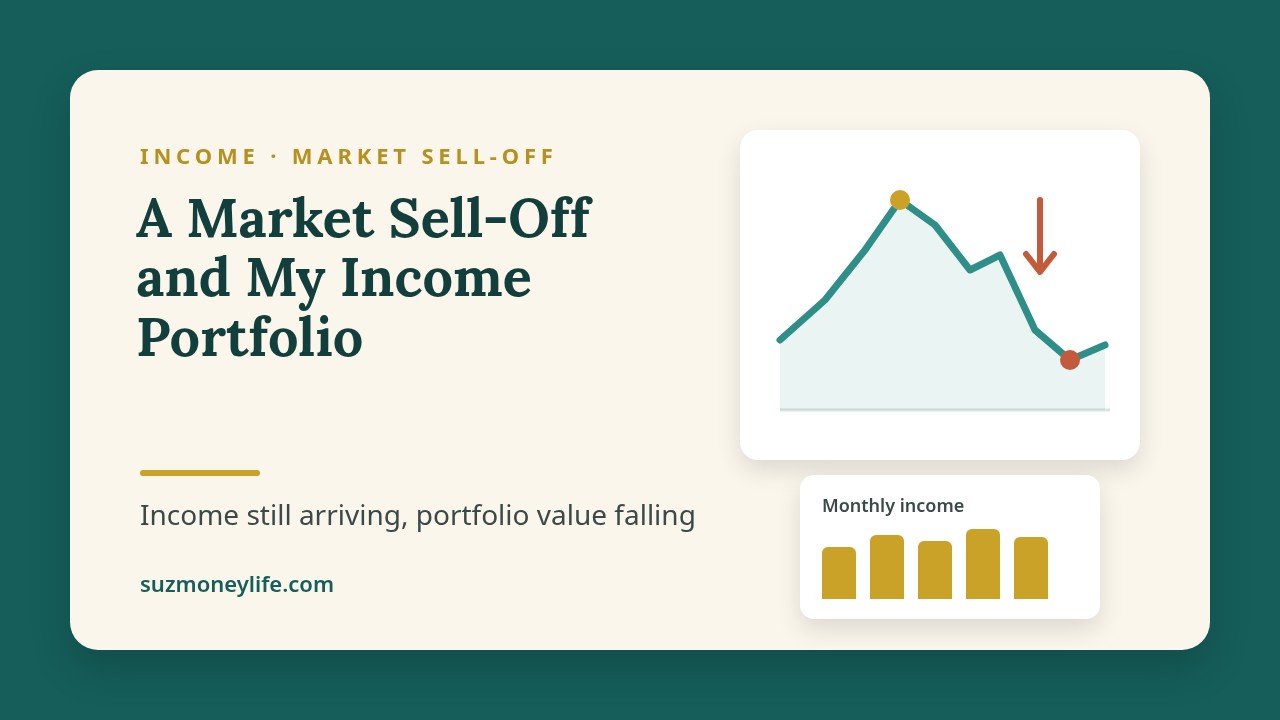
It’s easy to look at a monthly income report showing almost USD 5,000 and think everything is going well. But that number doesn’t tell readers what has happened to the value of my investments.
Some of my put options have resulted in share assignments. One example is VST, which had an unrealised loss of approximately USD 1,394 at the end of September 2026.
My BTCI position was also trading around 21% below my average purchase price in early October.
Neither loss disappears simply because I’ve collected options premiums or received fund distributions.
And this is one of the challenges I’m facing as I shift from building wealth to trying to generate income from it.
When I was working, I could continue adding fresh money to my portfolio every month. If the market fell, I had my salary to cover living expenses while waiting for investments to recover.
Without that regular income, preserving the capital I already have becomes more important.
I don’t want to reach a point where I’m receiving attractive monthly distributions while the portfolio itself keeps shrinking.
A strategy that generates plenty of cash but gradually erodes my capital isn’t going to support me indefinitely.
That’s something I’ll need to monitor closely in my future monthly updates.
Is USD 10,000 a Month Even Realistic With My Portfolio?
This is where the maths gets a little uncomfortable.
My goal is USD 10,000 a month, which works out to USD 120,000 a year.
If I had a USD 500,000 portfolio, generating that amount would require annual cash income equivalent to 24% of the portfolio’s value.
Since my portfolio is currently below USD 500,000, the actual percentage required would be even higher.
| Portfolio size (USD) | Annual income target | Required annual cash income rate |
|---|---|---|
| $300,000 | $120,000 | 40% |
| $400,000 | $120,000 | 30% |
| $450,000 | $120,000 | 26.7% |
| $500,000 | $120,000 | 24% |
Even the lowest figure in this table is extremely aggressive.
I could potentially collect substantial cash distributions and options premiums, but that doesn’t mean my investments are producing an equivalent return.
For example, if I receive USD 50,000 in cash distributions during a year but my portfolio falls by USD 70,000 in market value, I’m still worse off overall, ignoring other factors.
That’s why I don’t want to chase higher yields simply to make my monthly income reports look better.
To reach USD 10,000 a month sustainably, I’ll likely need a combination of portfolio growth, reinvestment and improvements to my income strategies.
I may also have to accept that the goal isn’t achievable with my current capital without taking risks I’m uncomfortable with.
And that’s okay. I’d rather find that out through tracking my actual results than convince myself a strategy is working just because cash keeps arriving.
Why I’m Still Giving This a Try
I haven’t set a deadline for reaching USD 10,000 a month.
I’m also not expecting my investments to replace my previous salary immediately. That’s one reason I spent years building up savings before leaving my job.
Having a financial buffer gives me time to see how things work without putting immediate pressure on the portfolio to cover every expense.
There will probably be months when investment income falls short, options trades go against me or I need to change my approach.
I might eventually discover that generating USD 10,000 every month isn’t sustainable with the amount of capital I have.
If that happens, I’ll need to rethink my plan.
For now, I want to track the money coming in alongside the changes in my portfolio value. That means reporting the distributions and options profits, but also acknowledging losses, mistakes and positions that aren’t performing as expected.
I think that’s the only way I’ll know whether my portfolio is genuinely moving me closer to financial independence.
Can My Portfolio Really Support Life Without a Paycheck?
For years, I focused on building my investment portfolio while earning a regular salary. I could invest new money each month and give my holdings time to grow.
Now I’m asking something very different: Can the portfolio I’ve built support my lifestyle without slowly eating away at the capital I’ve accumulated?
September’s USD 4,883.69 was a promising result, but one good month doesn’t tell me how much income I can sustain over the next five or ten years.
I still have plenty to figure out, especially when it comes to balancing income generation with long-term portfolio growth.
For now, I’m enjoying life without a regular paycheck and using this blog to document how the financial side works out.
Some months might look impressive. Others might be rather painful to write about.
Either way, I intend to share the actual numbers.
After all, I’m just as curious as anyone else to see whether this experiment will work.
Disclaimer: This article documents my personal investment journey and is not financial advice. Investing and options trading involve risks, including capital losses, assignment and distributions that may not be sustainable. Past performance does not guarantee future results.


Leave a Reply